The rules of search have changed. This guide by UniK SEO breaks down how modern SEO—powered by AIO, GEO, and AEO—can boost visibility, win AI trust, and turn your content into the answer across generative search, SGE, and beyond.
The world of modern SEO has changed dramatically. Search engines no longer rely solely on crawling, indexing, and ranking websites.
Today, artificial intelligence (AI) plays a central role in how information is interpreted and delivered, often instantly and without requiring a single click.
For businesses, this shift demands a new way of thinking. As an experienced GEO & SEO agency, UniK SEO is already helping companies adapt to this new landscape.
Has Your SEO Caught Up Yet?
Many businesses are still optimizing for the Internet as it was. Traditional SEO still matters, but it’s no longer enough on its own.
Search engines now use machine learning models that interpret intent, not just keywords, and users expect instant, conversational answers.
To stay visible, your content must be easy for AI systems to understand, and your brand must be credible enough for those systems to trust.
If your strategy doesn’t reflect AI-driven behavior or the expectations of future SEO, you risk being left out of the results.
That’s why choosing the right SEO agency is essential to ensure your brand stays competitive.
The Alphabet of Modern SEO: AIO, GEO, and AEO Explained
Search today is multidimensional. It combines generative engines, answer systems, conversational models, and traditional ranking algorithms. To succeed, your SEO must serve all of them.
That’s why AIO, GEO, and AEO matter. They don’t replace classic SEO; they expand it.
These frameworks help your content become machine-readable and usable as an answer, especially when reinforced with strategies such as structured content and link building.
AIO: AI Integration Optimization
AIO focuses on making your content understandable and valuable to AI systems.
Unlike classic SEO, which primarily communicates with search engine crawlers, AIO communicates with machine-learning models that evaluate intent, clarity, trust, and relevance.
AIO involves:
- Structuring content so AI can easily interpret sections, relationships, and hierarchy;
- Using high-quality, factual, expert-backed information;
- Supporting semantic SEO signals that help AI capture context;
- Ensuring your brand aligns with trustworthiness and expertise standards.
By optimizing for AI, you’re ensuring your content becomes part of the data ecosystem that powers generative answers, not just searchable web pages.
GEO: Generative Engine Optimization
GEO is all about visibility within generative AI search engines like Claude, Gemini, Perplexity, Copilot, and ChatGPT-powered search, as well as new tools emerging every month.
These systems don’t show a list of links. They read content and then generate an answer based on what they trust.
Your goal with GEO is to become part of the trusted source set that generative engines use to build their responses.
GEO requires:
- Clear explanations that are easy to cite or summarize;
- Industry authority and external credibility;
- Content formats that generative engines understand: FAQs, explainers, tutorials, definitions.
Where AIO makes your content machine-friendly, GEO ensures it is machine-chosen.
This approach shifts the focus from traditional keywords to entities, context, and brand trust. To successfully navigate this transition, partnering with a specialized geo services agency ensures your content architecture is built to be cited by AI.
AEO: Answer Engine Optimization
AEO prepares your content to be used as the direct answer to a user’s question, whether through a voice assistant, Search Generative Experience (SGE) result, or conversational search model.
It focuses on:
- Structuring information in question–answer formats;
- Writing concise and accurate responses;
- Anticipating natural-language queries;
- Providing clear definitions, lists, and explanations.
AEO is essentially about becoming the “featured answer” of the AI-driven world. While GEO focuses on being included in the source material, AEO focuses on being the final answer presented to users.
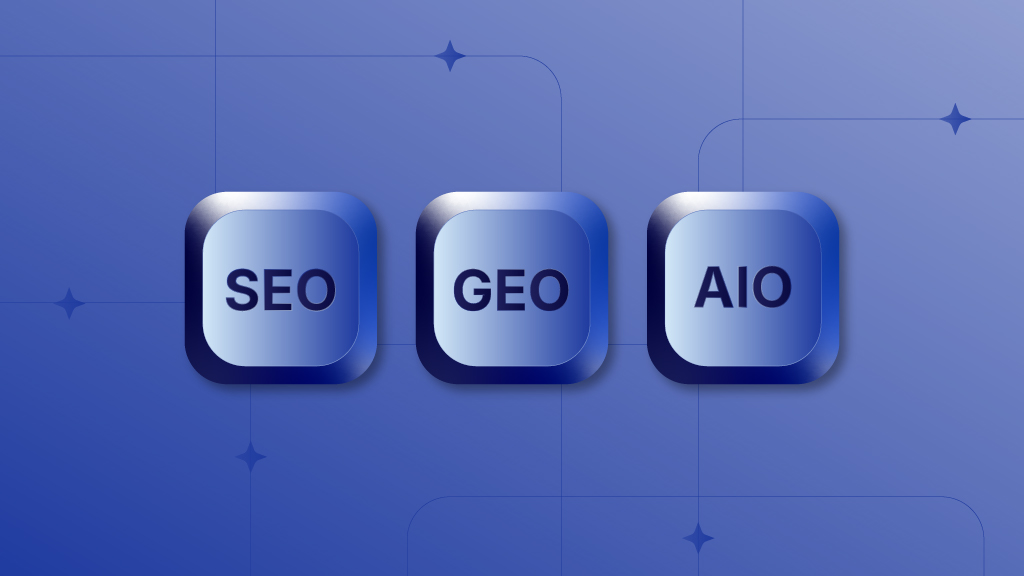
Together, AIO, GEO, and AEO form a comprehensive modern SEO strategy for today’s search landscape.
How Modern SEO Drives Business Growth
Adopting these new principles provides not only a technical upgrade but also a strategic business advantage. AI-powered search is quickly becoming the dominant way users discover information.
Companies that adapt early will be the brands AI trusts and highlights.
Here’s how these frameworks drive growth:
1. Visibility Beyond Traditional Rankings
Even when users don’t click, your brand can appear inside AI-generated responses. This creates new visibility channels you can’t afford to ignore.
2. Stronger Brand Authority
AI search engines favor brands that demonstrate expertise and credibility. Aligning with AIO, GEO, and AEO strengthens your reputation in both human and machine perception.
3. Competitive Differentiation
Most businesses are still unaware of how drastically search is shifting. Investing in modern SEO now positions you ahead of slower competitors.
4. Higher ROI on Content
Content written for both AI and humans lasts longer, performs better, and adapts more easily to future search changes.
At UniK SEO, we blend these principles seamlessly across technical SEO, content strategy, and link building to help brands grow sustainably in both human and AI-driven search.
Every recommendation is grounded in detailed SEO audits and reinforced by case studies that show exactly how this approach turns visibility into long-term results.
Now that you understand what AIO, GEO, and AEO mean in practice, the natural next step is measurement.
Defining a strategy is only half the equation — you also need to know how AI models like ChatGPT, Gemini, and Perplexity currently describe your business, where your brand is mentioned, and where competitors are taking the space you should occupy.
In our guide on how to audit brand visibility on LLMs, we walk through the exact prompts, benchmarks, and frameworks we use at UniK SEO to turn GEO and AEO theory into a repeatable audit process.
| 💡 Looking to Optimize for the AI Era? Conceptual understanding is just the first step. Explore our dedicated geo services to discover how we audit, map, and secure your brand’s presence inside generative search engines. |
Future-Proof Your SEO Strategy
The evolution of search isn’t slowing down, and the brands that thrive will be those ready for the next wave. AI-powered engines reward clarity, accuracy, trustworthiness, and structure.
The businesses that embrace these qualities today are building the foundation for tomorrow’s visibility.
UniK SEO is here to support that transition with tested methods and strategic expertise.
If you want to strengthen your presence in AI-powered search and ensure your business stays visible in the years ahead, you can request your free AI & SEO consultation with UniK SEO.
Let’s build a smarter, more resilient SEO strategy together.
Frequently Asked Questions (FAQs)
What is AIO in modern SEO?
AIO, or AI Integration Optimization, focuses on making content readable and valuable to AI systems by ensuring structure, clarity, relevance, and trust signals
How does GEO impact SEO visibility?
GEO (Generative Engine Optimization) helps your content appear in AI-generated responses by making it trustworthy, well-structured, and easy to summarize.
What is AEO, and how does it differ from GEO?
AEO (Answer Engine Optimization) is about making your content the direct answer to user queries, while GEO ensures your content is selected as a trusted source for generative responses.
Why is modern SEO important for AI-driven search?
Modern SEO aligns your content with how AI interprets, ranks, and delivers information, boosting visibility across search engines, voice assistants, and SGE experiences.
How can businesses future-proof their SEO strategy?
By adopting AIO, GEO, and AEO principles, businesses can optimize for both human users and AI systems, ensuring long-term relevance in the evolving SEO paradigm.