Schema Markup is structured code that tells search engines and AI exactly what your page contains, making it one of the highest-leverage technical investments a site can make in 2026.
Search engines are sophisticated, but they’re not mind readers. That’s where Schema Markup comes in: a layer of code added to a webpage that turns your content from something humans read into something machines can properly interpret.
At UniK SEO, with over a decade of technical SEO work across complex industries, structured data features in every audit we run and in every visibility challenge we solve.
What Schema Markup Actually Is
Schema Markup is a shared vocabulary of tags, maintained by Schema.org (https://schema.org/) and supported by Google, Bing, and Yahoo!, that lets website owners annotate their content in a way machines can read reliably.

It adds a structured layer underneath, in a format called “JSON-LD,” that communicates meaning directly to search engines and AI systems.
What Structured Data Communicates That Plain Text Can’t
Without structured data, a page describing a product or a service is just a block of text. Google and AI systems have to guess what it means.
Schema Markup changes that. By tagging content with standardized vocabulary from Schema.org, you explicitly tell the machine: this is the price, this is the author, this is the business name.
Text describes, but Schema confirms, labels, and connects. That’s the difference, and it’s significant once you understand how machines actually process a page.
Why AI Tends to Cite Pages That Describe Themselves Clearly
In early 2025, both Google and Microsoft publicly confirmed that schema markup influences how their AI features, including Google AI Overviews and Bing Copilot, select and cite sources. ChatGPT followed, confirming structured data plays a role in surfacing products and content in its results.
This matters because AI systems look for content they can trust and reuse without ambiguity. A page that explicitly declares who wrote it, what it covers, and where to verify that information is far more likely to be cited than one that leaves those details open to interpretation.
Making a site readable and trustworthy for LLMs goes beyond schema alone, but structured data is the technical foundation everything else sits on.
| 💡 Ready to make your site readable for AI models and search engines alike? Ensure your structured data and technical foundation are fully optimized by following our step-by-step Technical SEO Audit Checklist. |
Pages with clean, validated schema present their credentials in a format the machine can process immediately. That head start shows up in citations, and as more searches end in a generative answer, the stakes behind that head start keep rising.
The Schema Types That Offer the Most Practical Value
Not all schema types carry the same weight. These are the ones worth prioritizing in 2026:
- Article: Identifies content type, authorship, and publication date. Essential for editorial content.
- Organization/LocalBusiness: Builds entity recognition by connecting your site to your name, logo, and contact information. Particularly important for businesses running a local SEO strategy, where name, address, and phone (NAP) consistency across the web is non-negotiable.
- Product: Critical for e-commerce. Price, availability, and review data unlock rich results across Google Search, Lens, and Shopping surfaces.
- BreadcrumbList: Clarifies site hierarchy for crawlers and reinforces internal architecture signals. Low effort, consistently valuable.
- HowTo: Instructional content structured with HowTo schema is frequently cited in AI Overviews, making the intent of step-by-step pages explicit rather than inferred.
| 💡 To explore all supported structured data types and find the exact markup for your industry or content, browse the complete specification on the official Schema.org Full Type Hierarchy. |
How a Well-Marked FAQ Can Become the Answer Shown in Search
FAQPage schema has shifted. As of mid-2026, Google no longer shows rich FAQ accordions in search results for most sites. Google now reserves that display primarily for government and health publishers.
That doesn’t make FAQ content irrelevant. The format maps naturally to how AI systems construct answers: a clear question followed by a direct, contained response. Structured Q&A content remains among the most extracted material in AI-generated answers.
The practical approach is to keep well-written FAQ sections on relevant pages and maintain the markup for AI extraction, without expecting the enhanced SERP display that has now been largely removed.
The Markup Mistakes That Often Go Unnoticed
Most Schema Markup errors are silent. The page looks fine. The rich results simply never appear.
Here are a few common ones:
- HTML inside JSON-LD values: JSON-LD accepts only plain-text strings. Formatting tags inside a block break the parser and invalidate the entire markup without triggering any visible warning.
- Conflicting entity data: If your Organization schema lists a different address from your contact page, search engines encounter an entity they cannot verify, and trust signals drop across the website.
- Schema without matching page content: Google treats marking up information that doesn’t appear on the page as manipulation. It can lead to a site-wide manual action.
- Stale or deprecated types: The Sitelinks Search Box schema was deprecated in January 2026. Running old markup creates false confidence with no practical benefit.
- Mixed markup formats: Using JSON-LD and Microdata on the same page creates conflicting signals. Google recommends JSON-LD exclusively.
How Structured Data Changes the Way a Product Appears in Results
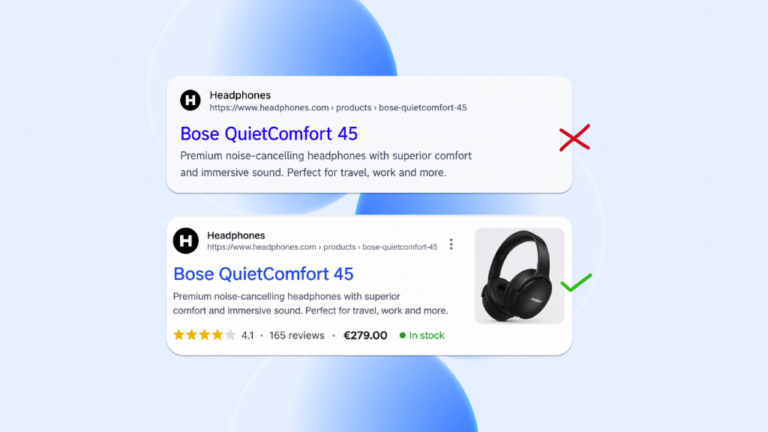
For e-commerce, structured data is the difference between a plain blue link and a result showing a price, a star rating, stock availability, and a product image before anyone clicks.
A complete Product schema with name, description, price, availability, ratings, and a linked seller entity makes a page eligible for Google Shopping features, Lens results, and rich product cards. It also provides the structured layer AI tools use to surface specific items in response to transactional queries.
The gap between a minimal Product schema and a fully attributed one determines whether a page competes where purchasing decisions actually happen.
How to Audit the Schema on a Website Step by Step
A clear, repeatable process covers most websites. Schema validation is one layer of a broader technical SEO audit, and this checklist shows where structured data fits in that picture.
- Crawl by page template: Group pages by type and check which schema is present on each. Coverage gaps by template are usually systematic, not random.
- Validate every block: Run each schema type through Google’s Rich Results Test and the Schema.org validator. Check for missing required fields and any syntax errors silently breaking blocks.
- Cross-check schema against visible content: Every value in the markup must appear on the page itself. If a price, address, or author name exists only in the code, fix it before anything else.
- Check for deprecated types: Compare your implementation against the latest Schema.org documentation and Google’s developer guidelines.
- Verify entity alignment: Name, logo, and contact details should match exactly across your Google Business Profile, LinkedIn page, and other authoritative external profiles. Consistency is how AI systems confirm a brand is a real, verifiable entity, and it’s also the same consistency that determines whether LLMs treat your brand as a source worth citing.
- Monitor in Google Search Console: The Enhancements section flags structured data errors and warnings by type. Schema drifts during redesigns and content updates, so regular reviews catch regressions before they affect visibility.
| 💡 Recommended Reading If you are building a complete Generative Engine Optimization (GEO) strategy, structured data is only the first step. To see how machine-readable code translates into real AI market share, read our full guide: How to Audit Brand Visibility on LLMs. Discover how to measure your presence inside ChatGPT, Claude, and Google AI Overviews, track brand mention sentiment, and ensure LLMs cite your content as an authoritative source. |
Conclusion
Schema Markup is not a trick or a shortcut. It’s the technical layer that tells search engines and AI systems who you are, what your content means, and why they should trust it enough to show it.
In a paradigm where generative answers are replacing ranked lists as the default way people get information, that clarity is no longer optional.
Three things to take away:
- Structured data is now an SEO and AI visibility tool: Google, Bing, and ChatGPT have all confirmed it influences what gets cited in AI-generated answers.
- The most common mistakes are silent: Mismatched content, HTML in JSON-LD, and deprecated types leave rich results on the table without any obvious signal that something is wrong.
- An audit is the only way to know where you stand: Assuming the schema is clean because it was once set up correctly is one of the most expensive assumptions in technical SEO.
At UniK SEO, we work across multiple industries, and structured data implementation is part of every technical audit we run.
If you want to know exactly where your site stands and what it may be costing you in search and AI visibility, our free consultation is where we start.
What You Need to Know…
Does schema markup directly improve search rankings?
Schema is not a direct ranking factor, but it enables rich results and AI answer extraction, driving significant gains in visibility and click-through rates.
What is the best format to implement schema markup?
JSON-LD is the industry standard in 2026, explicitly recommended by Google because it resides in a clean, standalone script block rather than breaking up visible HTML, making it far easier to implement, update, and maintain without code conflicts.
Do I need schema markup on every page of my website?
No. Focus schema markup selectively on pages where it adds clear value—such as Product schema on e-commerce items, Article schema on blog posts, and Organization schema on the homepage. Forcing irrelevant markup onto simple pages creates unnecessary technical noise rather than strategic clarity for search engines and LLMs.
Can schema markup help my website appear in AI Overviews?
Yes, absolutely. Clean and complete structured data—especially Article, Organization, and FAQPage markup—provides AI models with a clear, trustworthy signal about page content and authorship, significantly increasing the likelihood of being extracted and cited in Google AI Overviews.
How often should I review and update my schema markup?
Conduct a full schema audit quarterly, as well as immediately following site redesigns, CMS migrations, or content restructures. Because Schema.org specifications and Google guidelines update regularly—such as the deprecation of the Sitelinks Search Box in January 2026 and changes to FAQ rich results—treating structured data as a continuous maintenance layer prevents costly technical drift and maintains LLM citation eligibility.