A solid technical SEO audit checklist in 2026 covers 5 phases: crawlability, rendering, architecture, indexation & performance. AI tools help, but human oversight is essential for interpreting findings and protecting your organic traffic.
This article is written for every practitioner who owns technical SEO outcomes, regardless of the size of the organization behind them.
Built on years of cross-industry work at UniK SEO, an international SEO agency based in Portugal, the five-phase framework in this guide is designed to scale with your context.
How Often Should You Run a Technical SEO Audit?
A comprehensive five-phase technical SEO audit should be conducted at least every six months and immediately before and after any significant change, such as a migration, CMS upgrade, or domain change.
Lighter monthly monitoring of crawl stats, Core Web Vitals, and index coverage should run continuously between full audits to catch regressions early.
Why AI Can’t Outsmart a Broken Technical Foundation
There’s a seductive promise floating around the SEO industry right now: let AI handle your audit. Plug in a tool, hit run, and collect a pristine PDF of findings in minutes. Sounds efficient, right?
The problem is that efficiency without accuracy is just expensive noise. When it comes to technical SEO, noise can quietly kill your organic traffic before you even notice the damage.
The technical SEO audit checklist has been a cornerstone of search performance for over a decade. The fundamental pillars of crawlability, rendering, architecture, indexation, and performance haven’t gone anywhere.
What has changed is the complexity of the environment in which they operate.
In this paradigm, the old “AI vs. human” argument misses the point entirely. The real argument is simpler: AI is an extraordinary copilot, but a catastrophic captain.
What is a Technical SEO Audit in the Age of Generative Search?
What is a technical SEO audit when the search panorama now includes Google AI Mode, Perplexity, and ChatGPT Search sitting alongside traditional blue-link results?
| 💡 To ensure your website remains visible across these AI-driven platforms, explore our specialized GEO services and discover how the search landscape has evolved. |
A technical SEO audit has outgrown its original definition. Today, it’s a multi-system diagnostic spanning every automated layer influencing your visibility, from traditional crawlers to AI answer engines that prioritize structured, extractable content above all else.
The core components remain unchanged: crawl efficiency, index quality, rendering accuracy, performance stability, and machine-readable meaning. What’s changed is the cost of getting any one of them wrong.
A visibility gap now affects not just your Google rankings but your presence in AI-generated answers.
The Danger of Blind AI Trust: Why Automated Scans Fail Complex Architectures
Automated SEO audit tools are exceptional at collecting data points at scale. What they cannot do is interpret those data points within the context of your specific business architecture.
Consider three scenarios in which blind trust in AI produces dangerous recommendations:
Scenario #1: JavaScript Rendering
An automated scan flags “thin content” in your category pages. What it doesn’t tell you is that the content is substantial, but rendered entirely client-side, making it invisible to the very AI crawlers the tool flagged as important.
The recommendation to “add more content” addresses the symptom while ignoring the architectural root cause.
Scenario #2: Canonicalization
An AI tool recommends consolidating two near-duplicate product pages via the canonical tag. What it cannot know is that your merchandising team intentionally keeps both pages live as separate landing pages for paid campaigns.
Implementing the canonical would undermine a revenue-generating paid strategy for an organic gain that may never materialize.
Scenario #3: Crawl Budget
An automated scan flags 40,000 crawlable URLs as a crawl budget concern. What it cannot assess is whether those URLs include a faceted navigation cluster that, with proper parameter handling, could drive significant long-tail organic traffic.
Without a business context, the tool cannot distinguish between a session ID parameter that genuinely should be blocked.
The Human Legacy: Why You Need a Technical SEO Audit Consultant
A skilled technical SEO audit consultant brings something no AI tool currently possesses. It’s pattern recognition built from cross-industry architectural experience, combined with the ability to interrogate findings against business context.
The human legacy in technical SEO is that the checklist itself predates every AI tool in the market. The framework of crawlability, rendering, architecture, indexation, and performance was established through a decade of empirical testing, not machine learning. AI tools are trained on that expertise. The expertise itself still lives with the practitioners.
The Core Philosophy: AI as the Copilot, Human as the Captain
Before opening a single crawl report, the philosophy needs to be clear. The most dangerous SEO practitioner in 2026 is the one who relies only on AI tools.
Difference Between Technical and Content SEO Audits
The difference between technical and content SEO audits is fundamentally one of layer and dependency. Content SEO audits evaluate topical authority, keyword alignment, E-E-A-T signals, and user intent fulfillment. Technical SEO audits evaluate the infrastructure that makes all of that content findable in the first place.
The best-written page on the Internet is worthless to Google if Googlebot cannot crawl it, render it, or choose to index it. Technical SEO is the plumbing, whereas content SEO is the water. You can have the cleanest water in the world, but if the pipes are broken, nothing flows.
The critical implication is that technical issues must be resolved first.
Why Perform a Technical SEO Audit Manually in 2026?
Why perform a technical SEO audit at all when tools can scan thousands of URLs in minutes? The answer lies in what scanning actually does versus what auditing truly means.
Automated crawlers are exceptional at collecting data points: they flag a missing canonical tag, catch a redirect chain, or identify a slow TTFB.
What they cannot do is understand why a developer made a particular architectural decision, whether a crawl budget allocation aligns with business priorities, or whether a JavaScript rendering issue is causing content to be invisible to AI crawlers rather than just Googlebot.
Technical SEO Audit Benefits: Beyond Rankings to Business Revenue
The benefits of a technical SEO audit extend far beyond a ranking lift in a keyword report. When done properly, a comprehensive audit serves as a risk assessment, a revenue protection tool, and a competitive intelligence exercise.
Proper technical optimization increases organic traffic, but the real value compounds well beyond that single metric:
- Fixing crawl waste reduces server costs.
- Resolving Core Web Vitals issues cuts bounce rates and improves conversion funnels.
- Ensuring schema markup accuracy gives your content a direct pathway into AI Overview citations.
Phase 1: Crawlability and Log File Analysis (The Foundations AI Can’t Contextualize)
No phase of a website technical SEO audit is more foundational (or more commonly shortchanged) than crawlability. If Googlebot, GPTBot, or PerplexityBot cannot reach your content, nothing else in this checklist matters.
Configuring Your SEO Technical Audit Tools for Deep Crawls
The best SEO technical audit tools, including Screaming Frog, Sitebulb, Ahrefs Site Audit, and Botify, are your starting point. Before running your first crawl, configuration matters enormously.
- Set crawl user agents to Googlebot Smartphone as your primary agent: despite mobile-first indexing being standard for years, many developers still audit sites using desktop user agents. If your mobile navigation relies on a hamburger menu that is not in the DOM (Document Object Model) until clicked, you may be hiding your site structure from the primary crawler entirely.
- Configure crawl rate throttling to match your server capacity and avoid triggering rate-limiting or DDoS protections on shared hosting environments.
- Enable JavaScript rendering within your crawl tool where applicable, but compare rendered versus non-rendered output manually for JS-heavy page templates.
- Cross-reference your XML sitemap against what the crawler actually discovers: Discrepancies between submitted URLs and discovered URLs are diagnostic signals worth investigating closely.
Robots.txt and Crawl Budget Management
Your robots.txt file is a directive document, not a security wall. Treating it like the latter is a common source of catastrophic crawl errors. Validate every Disallow rule against your current site architecture. It is surprisingly common, especially post-migration, to find that a misconfigured rule is blocking crawlers from entire subdirectories of commercial content.
Crawl budget management in 2026 goes well beyond robots.txt. Managing your Index Budget, which is the number of pages a search engine deems worthy of retention, is just as critical as managing Crawl Budget.
A leaner site often ranks higher. Pruning low-quality pages, such as tag archives, outdated products, and thin pagination, concentrates link equity on high-performance assets.
Handling AI Bot Directives vs. Traditional Search Crawlers
Google added Google-Agent to its official list of user-triggered fetchers in March 2026, and it does not follow robots.txt in the same way a standard crawler does.
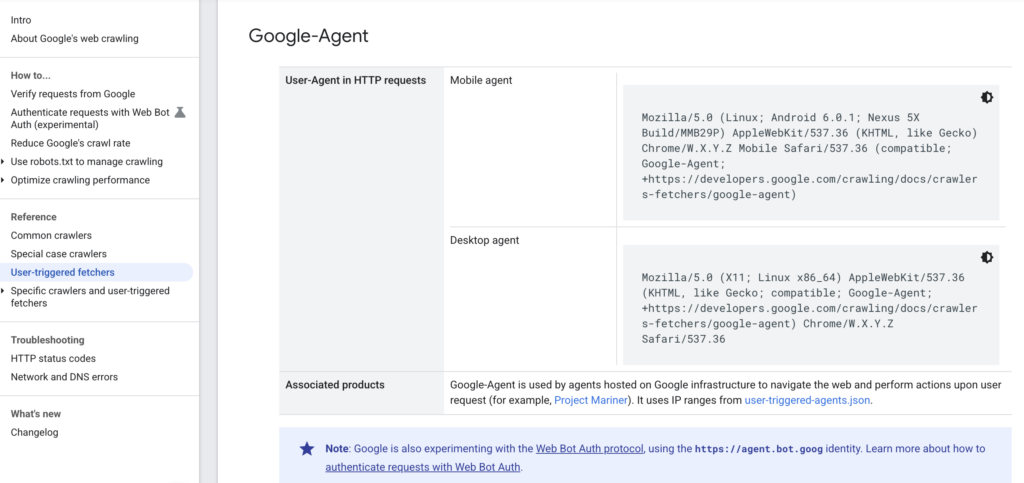
Your robots.txt strategy now needs to make deliberate, business-informed decisions for each bot class. GPTBot, ClaudeBot, PerplexityBot, Google-Extended, Bytespider, CCBot, and ChatGPT-User each represent different visibility and data-licensing considerations.
Blocking all AI bots by default is not a neutral decision, as it removes your content from the training and citation pipelines that increasingly influence branded visibility in AI-generated answers.
Log File Analysis: Catching the Blindspots of Automated Scans
Log file analysis is the single greatest differentiator between a junior and a senior technical SEO audit. Server logs reveal which URLs Googlebot actually crawls, not just what sitemaps claim exists.
Crawl simulation tools show you the potential; log files show you the reality. The distance between those two pictures is where the most valuable diagnostic work happens.
During log analysis, prioritize these four signals:
- Crawl frequency distribution: Is Googlebot spending budget on faceted navigation URLs or on your highest-revenue product and category pages?
- Status code patterns over time: A sudden increase in 404 responses in your logs often precedes a drop in indexed pages by several weeks. Catching it in logs gives you a remediation window that GSC data alone will not.
- Render budget versus crawl budget: Pages that are crawled but not rendered represent a category of issue that most automated tools never flag. This data lives exclusively in your logs.
- AI bot activity: If you’ve chosen to allow GPTBot and PerplexityBot, verify they are actually reaching the content you intend them to find.
How to Conduct a Technical SEO Site Audit for Orphan Pages
Understanding how to conduct a technical SEO site audit for orphan pages requires cross-referencing four data sources: your XML sitemap, crawl data, analytics data, and log files.
An orphan page is any page that receives no internal links, making it invisible to crawlers navigating via the link graph.
The methodology works as follows:
- Crawl your site, and export all discovered URLs.
- Extract all URLs from your XML sitemap.
- Pull all URLs with organic traffic from Google Search Console.
- Combine and deduplicate all three lists.
Any URL appearing in analytics or the sitemap but not in your crawl data is effectively an orphan. It requires either internal link repair or removal from the sitemap to avoid diluting crawl budget on unreachable pages.
Phase 2: Rendering and JavaScript SEO (Where AI Hallucinates)
If crawlability is the foundation, rendering is the walls. In 2026, the rendering landscape has fractured in a way that makes this the highest-risk phase of any technical SEO auditing on a website project involving modern JavaScript frameworks.
Client-Side Rendering (CSR) vs. Server-Side Rendering (SSR) Pitfalls
The core rendering problem has not changed, but its consequences have multiplied. When critical content is locked behind JavaScript, you create a paradox: a site that is highly interactive for humans but completely invisible to the very machines supposed to send those humans to your site.
Four of the six major web crawlers fetch only static HTML: GPTBot, ClaudeBot, PerplexityBot, and CCBot. Only Googlebot via headless Chromium and AppleBot render JavaScript.
This means that if your content lives in client-side JavaScript, it is invisible to the crawlers that train the models used by OpenAI, Anthropic, and Perplexity to power their AI search products. This is a fundamental visibility gap that no content strategy can make up for.
In technical audits, it’s common to find sites where the raw HTML is a mere 2KB of script tags while the rendered HTML is 50KB of rich content. To an AI crawler, that 2KB shell is the entire site.
How to Perform a Technical SEO Audit on JavaScript-Heavy Frameworks
Performing a technical SEO audit for frameworks like React, Vue, Angular, or Next.js requires a specific diagnostic workflow that goes beyond standard crawling.
- The cURL Test: Run curl -s [URL] on your critical page templates. If your key content, including product names, H1 headings, prices, and service descriptions, does not appear in the cURL output, GPTBot and ClaudeBot cannot see it either.
- View Source versus Inspect Element: View Source shows raw HTML before JavaScript execution. Inspect Element shows the rendered DOM (Document Object Model) after execution. The delta between these two views is your rendering gap. Document it by template type, not by individual URL.
- Crawl tool rendered versus non-rendered comparison: Export word counts and internal link counts from both rendered and non-rendered crawls. Flag templates where rendered content exceeds raw HTML content by more than 20%.
- Timeout failure identification: Complex JavaScript rendering that exceeds Google’s execution time limits creates a failure mode where content loads for users but is never seen by Googlebot. GSC URL Inspection may show a correct rendering because it re-renders the page on demand, but real-world crawl behavior can differ significantly.
Verifying DOM Generation and Googlebot Rendering Accuracy
Google Search Console’s URL Inspection tool remains your most reliable source of truth for how Google actually rendered a given page. Run spot-checks across your highest-traffic page templates. The pattern across a template matters far more than any individual page result.
Also, verify that title tags, canonical tags, and structured data are present in the rendered HTML rather than injected by JavaScript post-render. A canonical tag that appears only after JavaScript execution may be unreliable.
As of December 2025, Google clarified that pages returning non-200 HTTP status codes may be excluded from the rendering queue entirely. For Single Page Applications, this creates a critical risk: if an SPA serves a 200 OK shell that loads a “404” component via JavaScript, Google may index the error state as a valid page.
Phase 3: Architecture, URL Structure, and Internal Linking
Site architecture determines how efficiently crawlers move through your pages and how link equity reaches your most commercially important content. Structural decisions made at the template level compound across thousands of URLs, making this phase one of the highest-leverage areas of any audit.
The Technical Site Audit Guide to SEO Information Architecture
A clean technical SEO audit guide to information architecture follows one core principle: every page that deserves to rank should be reachable from the homepage within three clicks, and every internal link should use descriptive, keyword-informed anchor text.
Flat hierarchies outperform deep silos for crawl efficiency, and link equity flows more predictably across a site structured around topic clusters.
During your architecture review, map the internal link graph and look for the following issues:
- Pages with zero inbound internal links (orphans, as covered in Phase 1).
- Pages with an excessive number of inbound links that are not commercially important are a symptom of link equity dilution.
- Pagination structures that create deep crawl paths without corresponding commercial value.
- Navigation elements that only appear after JavaScript execution, such as hamburger menus and mega-nav dropdowns, are invisible to non-rendering crawlers.
Faceted Navigation and URL Parameter Control
Faceted navigation is one of the most complex challenges in technical SEO audits for mid- to large-sized websites. For e-commerce properties, filters for Size, Color, Price, and Material are a primary source of crawl waste. This is known as the «Combinatorial Explosion» problem.
A site with 1,000 products can inadvertently generate over 1,000,000 low-value URLs, bleeding crawl budget that should be serving commercial category pages.
The resolution toolkit includes four options:
- Noindex on faceted URL templates.
- Canonicalization pointing to the base category page.
- Disallow in robots.txt for parameter strings with no unique ranking value.
- Selective allowance with full content treatment for faceted pages that attract meaningful long-tail search volume.
E-commerce Site SEO Technical Audit: Scaling Architecture for Thousands of SKUs
An e-commerce site SEO technical audit operates at a different scale than most other audit types. With thousands of SKUs, the challenge is to systemize solutions across templates rather than fix individual pages.
Key considerations for e-commerce architecture include the following:
- Out-of-stock products: If a product is permanently discontinued, return a 410 status immediately. If it is temporarily out of stock, keep the page live with a 200 OK status, but ensure the “Recommended Products” or “Similar Items” section is rendered in the server-side HTML. This preserves crawlable value and maintains links to other relevant inventory.
- Category page depth: Pagination beyond page 3 rarely earns meaningful crawl budget. Evaluate whether infinite scroll or “Load More” implementations are being properly handled via rel=”next” hints or sitemap inclusions.
- Duplicate product variants: Color or size variants often create near-duplicate pages. The canonical strategy must be decided at the template level, not the product level.
Managing Dynamic URL Generation and Crawl Bloat
Session IDs, tracking parameters, and sort filters appended to product and category URLs are the most common source of unintentional crawl bloat in e-commerce architectures.
Audit your server configuration to strip these parameters before they reach Googlebot. Validate in GSC that no parameterized URLs are appearing in your Index Coverage report at scale.
Phase 4: Indexation, Canonicals, and Schema Markup
Indexation is where crawlability and rendering decisions translate into actual search visibility. A page that is crawled and rendered correctly can still fail to index if the signals governing its status are misconfigured or contradictory.
The Master List of SEO Technical Audit Items for Indexation
The following SEO technical audit items form the indexation layer of any comprehensive audit:
- Index coverage report segmentation: Segment by status – Valid, Excluded, Error, and Warning. Prioritize the Excluded bucket. It often contains crawled-but-not-indexed pages with significant content that Google is choosing to filter out.
- Noindex audit: Verify every noindex directive is intentional. Staging environment directives accidentally shipped to production are surprisingly common and can silently prevent entire sections of the site from indexing.
- Sitemap integrity: Your XML sitemap should contain only indexable, canonical URLs returning 200 status codes. Any sitemap URL that is redirected, canonicalized elsewhere, or returns a non-200 status creates indexation confusion.
- Hreflang reciprocity for international sites: Every hreflang annotation must create a reciprocal pair, and self-referential hreflang tags must be present on every page in the cluster.
- Index budget pruning: Pages with zero organic traffic over the last 12 months are candidates for removal or consolidation. Regular pruning concentrates link equity on high-performance assets.
Advanced Canonicalization and Indexing Directives
Canonical tags are among the most misused directives in technical SEO. A canonical is a hint to Google, not a command. Google will override a canonical if it disagrees with your assessment. This means a canonical tag alone is insufficient to resolve duplicate content if the duplicate page has strong inbound external links pointing to it.
The gold standard for de-duplication combines three elements: a canonical tag pointing to the preferred URL, internal link consolidation to that preferred URL, and a 301 redirect where the duplicate URL serves no distinct user purpose.
For paginated series, evaluate whether rel=”prev” and rel=”next” hint directives still carry functional value for your specific site. Use the log file evidence on how Googlebot treats your pagination depth to make that call.
Structured Data and Schema Validation for Generative AI Engine Readiness
Schema markup is increasingly used by AI search engines like Google AI Mode and Perplexity to determine what to cite in AI Overviews. This elevates structured data validation from an SEO hygiene item to a direct pipeline for AI-generated visibility.
Validate all schema implementations against Google’s Rich Results Test and the Schema.org official validator.
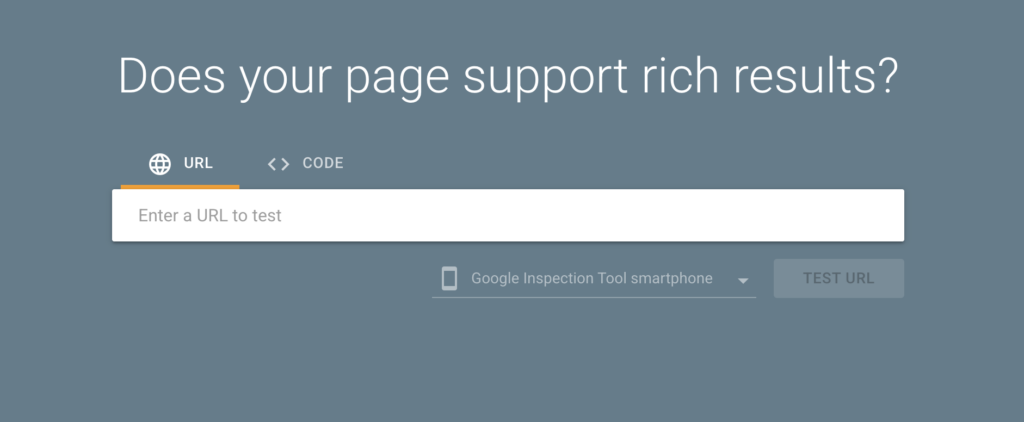
Priority schema types for 2026 include the following:
- Organization with full sameAs entity disambiguation linking to authoritative external sources.
- Product with nested Offers, AggregateRating, and Review markup for e-commerce pages.
- Article or BlogPosting with author entity markup pointing to a defined Person schema for E-E-A-T signal enhancement.
- FAQPage for content targeting conversational AI query patterns.
- HowTo for instructional content competing for featured snippets and AI summary inclusion.
| 💡 Breaking: The new Schema.org usage statistics dataset now tracks real-world structured data adoption metrics directly from Google’s web index. |
Phase 5: Core Web Vitals, Performance, and Security
Performance is a direct ranking input, measured by Google using real-user data rather than lab scores. Security misconfigurations at the server level can silently undermine crawlability and indexation in ways that the previous four phases will never surface.
Core Web Vitals in 2026: Real User Metrics (CrUX) Validation
Core Web Vitals are now a performance trifecta combining loading (LCP), responsiveness (INP), and visual stability (CLS).
The 2026 thresholds Google rewards in rankings are LCP under 2.5 seconds, INP under 200 milliseconds, and CLS under 0.1. All three are measured at the 75th percentile using real-user Chrome UX Report (CrUX) data.
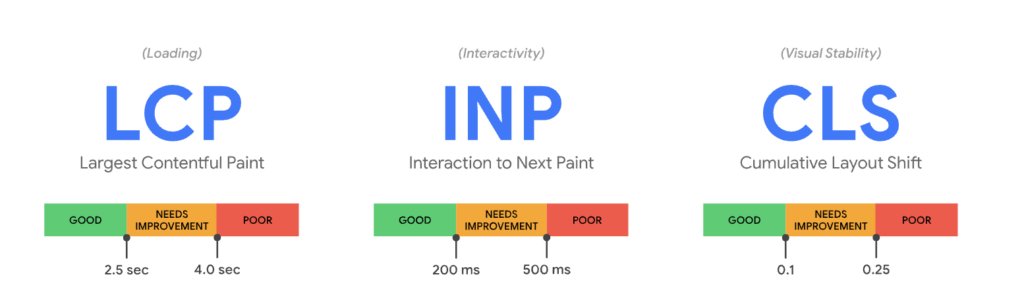
The most common mistake in Core Web Vitals audits is treating Lighthouse scores as a proxy for ranking signals. Lighthouse runs in a controlled lab environment and cannot replicate the network conditions, device variability, and interaction patterns that real users bring to your site.
Google bases ranking signals on CrUX field data, which captures actual user experiences across a 28-day rolling window. A page can score 45 in the field while returning a perfect 100 in Lighthouse, and it is the field score that affects your rankings.
INP deserves particular attention. It replaced FID as a Core Web Vital, and 40% of sites that previously passed FID now fail INP.
The reason is scope: INP measures all user interactions throughout the page lifecycle, not just the first input. This makes it far stricter and far more representative of real interactivity. For INP remediation, focus on three actions:
- Identify and break up long JavaScript tasks blocking the main thread.
- Audit third-party scripts such as chat widgets, tag manager containers, and ad pixels that hijack the main thread and prevent the browser from responding to user clicks.
- Defer non-critical JavaScript and use browser scheduling APIs to yield to user input events.
Configure performance alerts before your CrUX window degrades. Set threshold alerts at 80% of Google’s limits: INP above 160ms, LCP above 2.0s, and CLS above 0.08. This catches regressions from new deploys before they affect your 28-day rolling ranking signals.
HTTPS, Security Protocols, and Server Configuration
HTTPS is table stakes, but a security audit for technical SEO goes further than confirming a padlock icon:
- Mixed content detection: A single HTTP resource on an HTTPS page can suppress the secure connection indicator and, on some browsers, block resource loading entirely.
- HSTS headers: HTTP Strict Transport Security eliminates the redirect hop from HTTP to HTTPS, marginally improving page speed and security posture at the same time.
- X-Robots-Tag header audit: Server-level X-Robots-Tag headers can conflict with on-page meta robots directives in ways that produce unexpected indexation behavior, especially on dynamically generated pages.
- CDN configuration for AI bot access: Some CDN configurations block or throttle non-Googlebot crawlers. Verify that GPTBot, PerplexityBot, and ClaudeBot are not being served CAPTCHAs or experiencing rate limiting that prevents content ingestion.
- SSL certificate expiry monitoring: An expired certificate triggers browser security warnings and can cause Googlebot to stop crawling. Set renewal reminders with at least a 60-day lead time.
Executing the Audit: Frameworks for Agencies and Enterprises
A technically sound audit is only as valuable as the process behind it. How findings are structured, prioritized, and communicated determines whether recommendations get implemented or ignored.
The Blueprint: Your Definitive Technical SEO Audit Guide
A structured technical SEO audit guide for professional execution follows the five-phase sequence above. Each phase produces a prioritized findings document before the next phase begins.
This discipline is critical. Jumping to remediation before completing discovery leads to fixing only visible symptoms while root causes continue to generate new issues downstream.
Recommended tools for a comprehensive 2026 audit are:
- Crawling: Screaming Frog SEO Spider or Sitebulb for mid-size sites, and Botify or Lumar for enterprise JavaScript-heavy architectures.
- Log file analysis: Screaming Frog Log Analyzer, Splunk, or BigQuery pipelines for server log data at scale.
- Performance: Chrome DevTools Live Metrics tab, PageSpeed Insights for CrUX field data, WebPageTest for third-party script impact analysis.
- Indexation: Google Search Console Index Coverage report and URL Inspection, while Ahrefs and Semrush offer competitive index gap analysis.
- Schema validation: Google Rich Results Test and Schema.org Validator.
Technical SEO Auditing on Website Migrations and Relaunches
Technical SEO auditing on website migrations is a specialized discipline and one of the highest-stakes scenarios in the field. A site migration without a pre-launch audit and a post-launch monitoring protocol routinely results in 30% to 60% organic traffic losses that take 6 to 18 months to recover from.
The migration audit protocol must include the following steps:
- Pre-migration full crawl of the existing site for complete URL inventory and link equity mapping.
- Redirect mapping verification for every URL expected to change, validated before go-live.
- Canonical and hreflang reconciliation on the new architecture.
- Post-launch crawl comparison of old versus new within 48 hours of go-live.
- Google Search Console monitoring of Index Coverage, Core Web Vitals, and crawl stats daily for the first 30 days.
Choosing the Right Partner: Technical SEO Site Audit Agency vs. In-House Teams
The debate over technical SEO audit between agency and in-house execution is less binary than it appears.
In-house teams have an irreplaceable understanding of the business context. They know the CMS, the development constraints, the product roadmap, and the commercial priorities. On the other hand, agencies bring pattern recognition across hundreds of site architectures that in-house teams simply cannot accumulate at the same pace.
The most effective model in 2026 is a collaborative one. In-house teams own ongoing monitoring and implementation. Specialist technical SEO audit consultants conduct in-depth quarterly audits, delivering objective findings and development-ready recommendations. This combination eliminates both the blind spots of familiarity and the context gaps of pure outsourcing.
Why Brands Outsource Technical SEO Audit Services for Unbiased Validation
There is an objectivity problem with internal audits that no amount of good intent fully solves.
When a developer audits code they wrote, the psychological pressure to confirm existing decisions rather than challenge them is real and documented.
Outsourcing technical SEO audit services introduces a fresh perspective that is particularly valuable for identifying architectural decisions that made sense at one scale, but generate significant technical debt at the current site size. These are often decisions that internal teams have long since stopped questioning.
From Diagnosis to Execution: Technical SEO Audit and Implementation Services
An audit that produces no change is an expensive report-generation exercise. The value of a thorough technical SEO audit lies entirely in what happens after the findings document is delivered.
Prioritizing the Checklist: Impact vs. Development Effort
Every finding in a technical SEO audit deliverable should be scored on two axes: estimated traffic impact and development effort.
- Traffic impact is rated High, Medium, or Low based on affected page volume and current ranking proximity.
- Development effort is rated based on technical complexity and estimated engineering hours.
A simple 2×2 impact-effort matrix clearly reveals your starting point.
The high-impact, low-effort quadrant typically includes canonicalization fixes, robots.txt corrections, redirect chain collapses, and schema markup additions. These changes can often be completed in a single development sprint, with measurable results visible within 28 to 42 days as reflected in CrUX data.
How to Translate a Technical SEO Audit Service into Developer Tickets
The transition from audit finding to developer ticket is where most technical SEO audit projects lose momentum. SEO findings written in search-optimization language rarely communicate effectively with engineering teams working within sprint backlogs.
Every recommendation must include four components:
- The problem stated in terms of technical behavior. For example: “302 redirects on 47 URLs passing link equity incorrectly.“
- The expected behavior after the fix. For example: “301 permanent redirects on all affected URLs.”
- The validation test that the developer can run to confirm the fix. For example: “cURL -I [URL] should return 301 status with Location header pointing to [target URL].”
- The business impact in accessible language. For example: “Consolidates ranking signals for 47 product pages and recovers link equity currently split across redirect hops.”
This framing builds trust with development teams and dramatically improves implementation rates.
Conclusion: The Irreplaceable Value of Human Strategic Oversight
In 2026, the tools have gotten remarkably good at the parts that do not require judgment. They crawl fast and can write a Python log analysis script in seconds.
What they cannot do is interpret. They cannot tell you whether a decision reflects a deliberate strategy or a developer’s misunderstanding.
AI audit tools are best used for classification, pattern detection, and data processing. Use them for what they are built for, and ensure that a trained human interprets the output, sets priorities, and makes the calls only someone with a full strategic context can make.
Your Next Steps: Beyond the Checklist
If you have read this far, you already understand that a checklist is a starting point and that the real work is execution.
Whether you are preparing for a migration, diagnosing a post-algorithm-update traffic drop, or building a new e-commerce architecture from the ground up, the five-phase framework above gives you the structure to approach any technical SEO audit with the rigor and confidence it deserves.
The UniK SEO team specializes in deep technical SEO audits that combine expertise with the strategic business context that automated tools can never replicate.
Contact us for a free SEO consultation or to discuss your audit requirements.
Frequently Asked Questions (FAQs)
How often should you run a technical SEO audit?
A comprehensive technical SEO audit should be conducted at least every six months, and immediately before and after any major site change, such as a migration, CMS upgrade, or domain change. Between full audits, lighter monthly monitoring of crawl stats, Core Web Vitals, and index coverage should run continuously to catch regressions early.
What is a technical SEO audit?
A technical SEO audit is now a multi-system diagnostic that spans every automated layer influencing a website’s visibility, from traditional search crawlers like Googlebot to AI answer. Its five core components are crawl efficiency, index quality, rendering accuracy, performance stability, and machine-readable structured data.
What is the difference between a technical SEO audit and a content SEO audit?
The two disciplines operate at different layers. A technical audit evaluates the infrastructure that enables content to be findable: crawlability, rendering, site architecture, indexation, and performance.
A content audit focuses on topical authority, keyword alignment, E-E-A-T signals, and user intent. Technical issues must always be resolved first, because even the strongest content is invisible to Google if Googlebot cannot crawl or render it.
What are the Core Web Vitals thresholds for rankings in 2026?
Google’s current benchmarks require LCP (Largest Contentful Paint) under 2.5 seconds, INP (Interaction to Next Paint) under 200 milliseconds, and CLS (Cumulative Layout Shift) under 0.1.
All three are measured at the 75th percentile using real-user Chrome UX Report (CrUX) field data, which means Lighthouse lab scores are not a reliable proxy for ranking signals.
Why can’t AI tools replace a manual technical SEO audit?
Automated tools are effective at collecting data at scale, but they cannot interpret findings within the context of a specific business. They have no way of knowing whether a JavaScript rendering issue is hiding content from AI crawlers, whether a canonicalization recommendation conflicts with a paid media strategy, or whether a large crawlable URL set contains high-value long-tail facets worth preserving. Translating raw findings into sound decisions requires human judgment and strategic context.