47% of AI responses include zero outbound links. We tested 6 models across 12 adult industry categories to find out exactly which kind of brands get named, which ones vanish, and what separates the two.
For years, the SEO for the adult industry played the same game as everyone else: rank on Google, drive traffic, and get discovered. That game is not over, but a new one has started alongside it, with completely different rules.
Large language models like ChatGPT are rapidly becoming the first place people turn when they want information. And unlike Google, these systems don’t just filter or rank content; they decide whether to engage with a topic at all. For the adult sector, that distinction matters enormously.
This is the core finding of a 2026 study by UniK SEO, an SEO agency in Portugal: adult-industry businesses are no longer just competing for rankings. They are competing to exist in AI-generated answers at all.
Why AI Search Is Fundamentally Different from Google
To understand the challenge, it helps to be clear about what has actually changed.
When you search on Google, the engine looks at billions of pages and returns a ranked list of links. You choose where to go. Even if Google applies a filter or deprioritizes certain content, that content still exists. It still has a URL, it can still be found. Visibility is reduced, not eliminated.
LLMs work differently. They write an answer, and before they write anything, they make a judgment call: is this something I should respond to? If the answer is no, the response gets refused, vague, or redirected toward something safer. There is no list of results to scroll past. There is just silence, or a non-answer.
For adult-industry businesses, this creates a visibility problem that SEO for AI alone cannot solve in the traditional sense.
The Role of Framing: How You Ask Changes Everything
Here is something that may seem counterintuitive: in LLM-based search, the same question can get completely different responses depending on how it is worded.
Ask about a topic using clinical, educational, or neutral language, and a model is far more likely to engage. Use phrasing that sounds explicit, transactional, or service-oriented, and the response shuts down, even if the underlying intent is identical.
This matters for businesses because most users don’t search the way a brand strategist would want them to. They use casual, direct, sometimes blunt language. That phrasing has real consequences for whether a brand gets surfaced or not.
It also creates a strategic opportunity for GEO (Generative Engine Optimization). The way a brand presents itself online, through its language, its framing, and its content structure, now directly influences whether an AI will mention it in response to a relevant query.
How the Study Was Conducted
To understand these dynamics in practice, the UniK SEO research team tested six AI systems: ChatGPT 5.2, Claude (Sonnet 4.5), Grok, Gemini 3, Perplexity, and Venice AI.
These six were chosen specifically because they represent a wide range of moderation philosophies and user bases:
- ChatGPT and Gemini are mainstream, general-purpose tools with large and diverse audiences;
- Perplexity is built around AI-assisted search and tends toward citation-heavy responses;
- Grok, developed by xAI, has positioned itself as a less restrictive alternative;
- Claude, developed by Anthropic, is known for applying stricter safety guidelines;
- Venice AI is a smaller, privacy-focused platform that attracts users specifically looking for fewer content restrictions.
Together, they give a representative picture of the AI search landscape as it stands today.
Each model was given queries across twelve adult-industry categories, chosen to cover the full spectrum of the industry—from segments close to mainstream consumer content to those involving explicit or transactional services:
Sexual Wellness & Education, Sexual Health Services, Adult Retail (Sex Toys), Lingerie & Sensual Apparel, Adult Dating Platforms, Adult Nightlife, Creator Platforms, Webcam Platforms, Porn Publishers, Fetish & BDSM, Sex Work Services, and Erotic Massage.
Every response was scored on a simple four-point scale:
Responses were also checked for two signals that matter most from a business perspective:
- Whether the model included any links to external sources
- Whether it explicitly named any specific brands or platforms
These two signals determine whether AI visibility actually translates into anything commercially meaningful for the businesses involved.
The goal was not to judge which AI has the best policy. It was to document what actually happens when a real user asks a real adult-industry question on each platform.
Get the Free AI Search Report Now!
Get the Free AI Search Report Now!
Check your inbox!
We sent your download to your email. It should arrive in a few minutes.
Your full research report will be delivered directly to your inbox within a few seconds!
The Results: Some Models Are Far More Open Than Others
The differences between models are striking. These are stable, systematic patterns that reflect how each platform has chosen to handle sensitive content at its core.
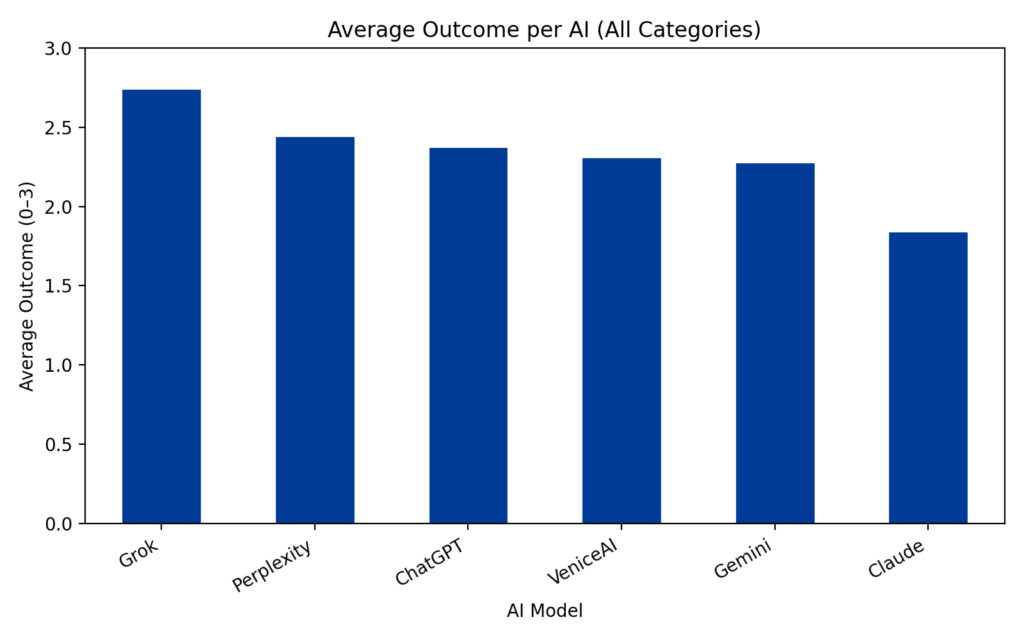
- Grok comes out on top across almost every category. It produces the most substantive answers, refuses the least, and is the most likely to name specific brands.
- Perplexity and ChatGPT perform well overall, though ChatGPT tends toward more mediated, careful responses that engage with topics without always going into full detail.
- Gemini and Venice AI sit in the middle. They are willing to engage, but often with a degree of reframing that softens or generalizes the response.
- Claude is the most restrictive model in the study, recording the highest rate of refusals and the lowest share of useful responses across categories.
Three distinct behaviors emerge from the data:
- Some models refuse outright, offering nothing or redirecting to an entirely unrelated topic without acknowledging the original intent of the question;
- Some models mediate, meaning they respond, but in abstract or sanitized terms that strip out anything commercially specific or useful. The answer exists, but it doesn’t name anything, link to anything, or help a user actually find what they were looking for;
- Some models engage directly, providing specific, actionable answers that include brand names, platform comparisons, and enough detail to be genuinely informative.
Understanding which model does what is not just an interesting data point. It has real implications for where adult-industry brands should focus their visibility efforts and how they should structure their content.
Not All Categories Are Equal
One of the clearest findings in the UniK SEO study is that AI moderation is applied primarily at the category level, not just at the level of individual models or individual queries.
Some segments of the adult industry are consistently accessible across all platforms. Others are consistently blocked, regardless of which AI system is used or how the question is phrased.
- High visibility across all models: Sexual Wellness & Education, Sexual Health Services, Lingerie & Sensual Apparel, and Adult Dating Platforms all perform well consistently. These categories benefit from being framed, or easily reframeable, as informational, health-related, or consumer-oriented. Every model tested was willing to engage substantively, and brand mentions were common. A business in these segments has a genuine opportunity to build visibility across the full range of AI platforms;
- Visibility depends on which model you are on: Creator Platforms, Webcam Platforms, Porn Publishers, Sex Toys, Nightlife, and Fetish & BDSM sit in a middle zone where platform choice has a significant impact. Grok handles these categories openly and with specific detail. Claude largely does not engage meaningfully. The gap between the most and least permissive models in these categories is wide enough that a brand could be highly visible on one platform and essentially invisible on another, for the exact same query. For businesses in these segments, knowing where to concentrate content and optimization efforts is particularly important;
- Consistently restricted across the board: Sex Work Services and Erotic Massage face near-universal restrictions across all six models. No framing adjustment reliably unlocks meaningful responses in mainstream AI systems for these categories. Grok offers some limited engagement, and Venice AI provides a secondary option, but the overall picture is one of very constrained visibility regardless of approach.
It is also worth understanding how restriction actually works in practice. It is rarely a clean, binary block. More often, it functions as a gradual fade. The model responds, but becomes increasingly vague, generic, and brand-free as the query approaches more sensitive territory. A business might technically “appear” in an answer, but in a form so diluted and nonspecific that it offers no practical visibility benefit to anyone searching for it.
The Link Problem: AI Doesn’t Send Traffic the Way Google Does
Even when an AI engages with a query, that does not automatically mean traffic or brand exposure for the businesses involved. This is one of the more commercially important findings in the study, and one that is easy to overlook.
Across all responses, 47% included no outbound links whatsoever, even when the answer was substantive and detailed. This is a structural feature of LLM design: these systems are built to answer, not to refer. They synthesize information and present it as a self-contained response.
The original source, whether a website, a brand, or a specific platform, may have informed the answer without ever being credited, named, or linked.
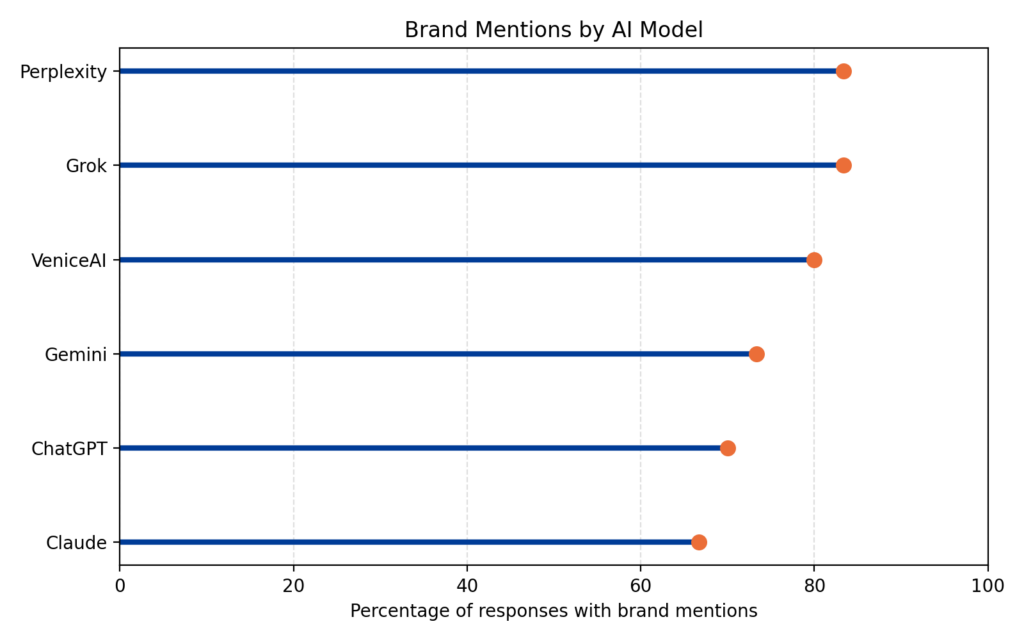
Brand mentions follow a similar pattern of unevenness across models. Perplexity and Grok name specific platforms and companies most frequently, while Claude and ChatGPT are considerably more reserved.
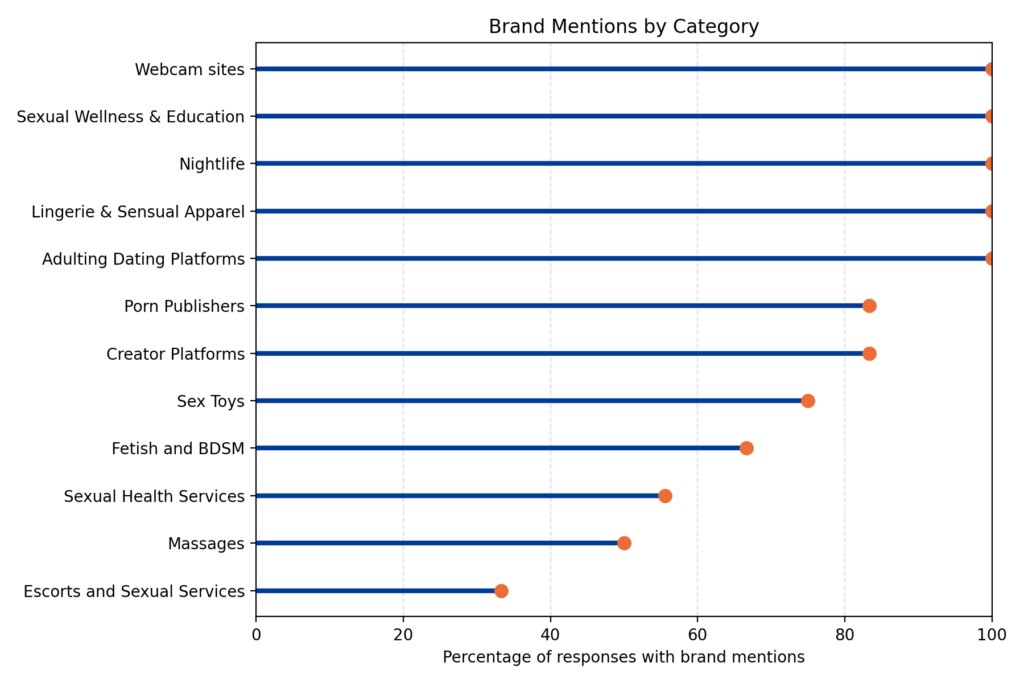
At the category level, the segments most likely to generate brand mentions, such as Webcam Sites, Lingerie, and Sexual Wellness, are very different from those least likely to do so, such as Escorts and Erotic Massage.
This is where digital PR becomes newly relevant for adult-industry businesses. Getting a brand mentioned, cited, or referenced across credible online sources is becoming part of the information base that AI systems draw on when generating answers.
A brand that appears consistently across authoritative, indexed sources is more likely to surface in AI-generated responses, even when no direct link is provided. Building that presence deliberately and at scale is one of the more concrete strategies available in this new environment.
What Adult-Industry Businesses Can Do About It
The patterns observed in this study are not random, and that means they can be worked with strategically. The following approaches consistently emerge from the data as factors that increase the likelihood of appearing in AI-generated responses.
Lead with information, not promotion
A deliberate content marketing strategy built around education, comparison, and guidance will consistently outperform purely promotional content in AI-generated responses. It means building genuinely useful context that models are comfortable surfacing because it reads as informational rather than transactional.
The brands that invest in this kind of content now are building an asset that will compound in value as AI search grows.
Separate your content by purpose
Informational pages and transactional pages should be structurally distinct. A model is considerably more likely to reference a well-written guide to a product category than a product listing page.
Having clear, standalone educational content gives AI systems something they can engage with and cite without triggering content restrictions.
Use plain, descriptive language
Explicit or suggestive phrasing consistently triggers more restrictive handling across all models, even when the underlying topic is entirely legitimate. Language that reads as neutral, clinical, or consumer-oriented performs significantly better. This applies not just to page copy but also to headings, metadata, and any structured data a model might use to understand what a page is about.
Think about which AI platform matters most for your segment
If you operate in a category where visibility is highly model-dependent, such as Creator Platforms, Webcam, or Fetish & BDSM, then Grok and Venice AI are the environments most likely to engage with your content openly. For more mainstream-adjacent categories, ChatGPT, Gemini, and Perplexity offer strong and consistent brand surfacing and reach significantly larger audiences.
Do not abandon traditional SEO
Google still processes roughly 490 billion searches per month. ChatGPT, by comparison, handles around 5.7 billion monthly visits. AI search is growing fast and cannot be ignored, but it complements traditional search rather than replacing it, at least for now.
The brands best positioned for the next few years will be those that treat AI visibility and search visibility as parallel priorities rather than alternatives.
| 💡 Balance AI Search with Core Rankings: Optimizing for AI models is crucial, but keeping your foundational search visibility strong is what fuels long-term growth. Dive into our complete adult SEO guide to align your technical structure, content architecture, and AI strategy for 2026. |
The Gatekeepers Have Changed
The SEO for the adult industry has always had to navigate visibility challenges. What is new is not the existence of gatekeepers. It is who the gatekeepers are and how they operate.
AI systems do not respond to link-building, keyword density, or domain authority the way Google does. They respond to how content is framed, how safe a topic appears, and what category it falls into.
Businesses that understand these patterns and build their strategies around them will have a real advantage as AI search continues to grow. The shift is already underway. The question for adult-industry brands is whether they adapt proactively or watch their visibility quietly erode in the channels that are becoming the default entry points for the next generation of users.
If you want to go deeper, the full technical report covers every category in detail, including the complete model-by-model outcome matrix, brand visibility data across all twelve segments, and platform-specific recommendations for where to focus your efforts.
Download the full study and get the complete picture of How AI Systems Handle Adult Industry Queries today!
Get the Free AI Search Report Now!
Get the Free AI Search Report Now!
Check your inbox!
We sent your download to your email. It should arrive in a few minutes.
Your full research report will be delivered directly to your inbox within a few seconds!
Frequently Asked Questions (FAQs)
1. Which AI model performs best for adult industry queries?
In the UniK SEO study, Grok recorded the highest average outcome score across all twelve categories tested, producing the most substantive answers and the fewest refusals. Perplexity and ChatGPT followed, while Claude was the most restrictive model overall, with the highest rate of non-answers and generic responses throughout the study.
2. Which adult industry categories got the most visibility across AI platforms?
3. Are there adult industry categories that no AI model will engage with?
Sex Work Services and Erotic Massage face near-universal restrictions across all six models in the study. Even Grok, the most permissive platform tested, offers only limited engagement with these categories. No framing adjustment was found to reliably unlock meaningful responses for these segments in mainstream AI systems.
4. How often did AI models mention specific brand names in their responses?
Brand mentions varied significantly across models and categories. Perplexity and Grok named specific platforms and brands most frequently. Claude and ChatGPT were considerably more reserved. Categories like Webcam Sites, Sexual Wellness, and Nightlife generated the highest brand mention rates, while Escorts and Erotic Massage generated the lowest across all models tested.
5. What does the UniK SEO study reveal about AI responses and outbound links?
47% of all responses recorded in the study included no outbound links whatsoever, even when the answer itself was detailed and substantive. This means that nearly half of all AI responses absorbed the query and resolved it internally, with no referral back to any external source. For adult brands, this highlights a critical gap between being known to an AI system and actually generating traffic from it.